




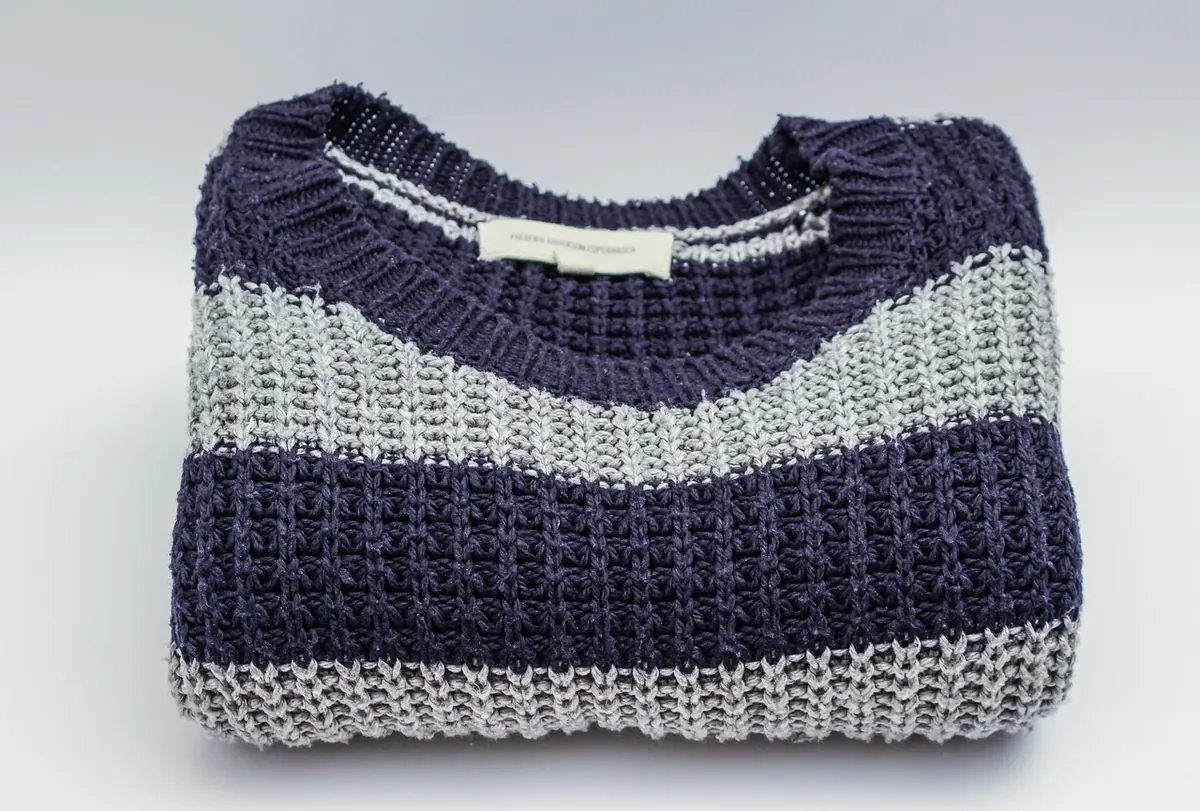

A cardigan can be the easiest layer you own, or the reason your coat won't close. The difference is rarely the cardigan itself. It's the order you put things on, where each layer stops, and how much thickness you've stacked at the shoulders, underarms and waist. This checklist is the version worth running through in front of a mirror with three options on the bed.
Once you know your own numbers — sleeve length, hem length, how much shoulder room you have to give — layering stops being guesswork. Start with the formulas below, then adjust to what's already in your wardrobe.
Choose the knit weight before the outfit
Cardigans range from paper-thin fine-gauge merino to hand-knit cables, and the fabric decides where a cardigan can go. A quick test: fold the front edge in half and pinch it between your fingers. If it feels like a sheet of paper, it can sit under almost anything. If it feels like a folded towel, it belongs on the outside.
- Under a coat or blazer: fine-gauge merino, cashmere or a smooth cotton blend, with set-in sleeves. Raglan sleeves are comfortable but can bunch at the shoulder under a stiff coat.
- Worn alone over a tee or shirt: mid-weight wool, soft rib knits, small cables, a neat crew or V neck.
- As the statement layer: chunky cables, brushed mohair, balloon sleeves, big shawl collars. These are outer layers, full stop.
- Warm-weather layering: cotton, linen blends, loose open knits. Hold them up to a window — if you can see daylight through the stitches, they'll breathe.
The mistake most of us make is treating a heavy cardigan as a mid-layer because it looks slim on the hanger. It isn't. Bulk shows up first at the armhole, then along the button placket, then at the waist where the hem meets a waistband.
The under-coat formula
Base layer, cardigan, coat — thinnest closest to the body. That's the whole formula, with two details that decide whether it works.
First, sleeve length. Your cardigan sleeve should end at or above your coat sleeve. If it's longer, push it to bracelet length so the extra fabric sits at the bend of your elbow rather than cramming into the coat cuff. Second, the coat should close without a fight. If you have to haul the front edges together, the cardigan isn't the problem — the coat is one layer too small for the outfit you want.
Rule of thumb: if you can feel a layer while standing still, you'll resent it by lunchtime.
Button plackets matter more than people expect. A thick, chunky button band creates a ridge straight down your front under a coat. Fine-gauge cardigans with small buttons or a zip disappear. If you love a cardigan with statement buttons, wear it open over the top of everything instead.
Over dresses: think in thirds
When you layer over a dress, you're drawing lines across your body, and those lines need a reason to be there.
A cropped cardigan over a midi dress marks your waist and gives you a top-and-skirt proportion. A longline cardigan worn open over the same dress creates one long column. Both work. What rarely works is a hem that lands at the widest point of your hip or the widest part of a full skirt — it chops the silhouette exactly where you don't want attention. Move that hem up a hand's width or down past the widest point.
With belted or wrap dresses, wear the cardigan open and let the dress's own waistline do the work. Two waists competing never looks intentional. If the dress is very full, keep the cardigan short and fitted; if the dress is a straight slip, a longer, softer cardigan balances it.
Belt the cardigan, not the outfit
Belting a cardigan is the fastest way to turn a roomy knit into something with shape, but placement decides the result. For a cropped or hip-length cardigan, belt at your natural waist. For a longline cardigan, drop the belt to your hip bone or a hand's width below it, which lengthens the line instead of cutting you in half.
Match the belt to the knit: a slim leather or woven belt over fine gauge, and either no belt at all or a soft tie belt over chunky wool. Wide, stiff belts compress thick knits and push the fabric outward above and below, which reads as a shelf. Fasten the cardigan first, then belt it, and leave the bottom button undone so the fabric doesn't pull tight across your hips.
Open, half-buttoned, closed: three different garments
How you fasten a cardigan changes what it does:
- Fully buttoned: it behaves like a jumper. Best in fine gauge, tucked into high-waist trousers or a skirt for a clean line.
- Top two buttoned, rest open: creates a narrow V and frames a scarf or necklace. Good for mid-weight knits.
- Buttoned from the middle down: keeps the front smooth and puts the visual waist where the buttons begin.
- Completely open: two vertical edges that lengthen the body. The safest option with anything voluminous underneath.
One cardigan, three seasons
Spring and early autumn
A cotton or fine-merino cardigan worn open over a tee, with sleeves pushed to the elbow, handles the in-between weeks. Add a light scarf rather than a heavier knit when the temperature drops.
Summer evenings
Carry a thin cardigan rather than wearing it. Draped over the shoulders or tied loosely at the waist, it works with a slip dress or linen trousers and comes off in seconds.
Winter
Use two weights: a fine-gauge cardigan as the mid-layer under your wool coat, and a chunky one for indoors over a shirt. Never both at once unless the outer one is genuinely oversized.
The two-minute mirror check
Before you leave, run through these:
- Raise both arms overhead. Does the hem stay near your waistband, or ride up past it?
- Close your coat. Does it meet without pulling at the buttons?
- Name the bulk point. Shoulder seam, armpit or waist — if you can feel one, remove a layer or swap the knit.
- Check the line from neck to hem. You want one long vertical, not a stack of horizontal edges.
- Sit down. If the cardigan bunches hard behind your back, it's too thick for that coat.
Layering well isn't about owning thinner clothes. It's about putting the thickness where it doesn't show: close to the body, smooth at the shoulders, and never doubled up at the waist. Get those three right and the cardigan stops being the layer you tolerate and becomes the one you reach for first.
Photo: wal_172619 / Pixabay